BJJ Gym Management Software: What Should It Actually Do?
By iRoll BJJ Updated
Open any gym-software homepage and the feature list looks heroic: billing, scheduling, CRM, apps, reports, maybe a belt field thrown in for good measure. Sit through three demos and they start to blur. Everyone has memberships. Everyone has a timetable. Everyone promises to “save you time.”
The useful question is narrower: which awkward academy jobs does this thing actually take off your plate when twenty people are tying belts and someone is asking whether their card went through?
BJJ gym management software should help you follow up enquiries, publish a timetable people can trust, collect memberships without chasing every card yourself, keep membership status clear when someone walks in, and record attendance and ranks so coaches aren’t relying on memory. The better platforms connect those jobs. Weaker ones still tick “billing”, “attendance” and “rank” on a comparison grid, but the pieces don’t share information — so you’re back in the group chat asking who paid, who is coming tonight, and answering whether Thursday is still no-gi.
This article is about those jobs — not another buying scorecard. For how to compare products once you know what you need, see how to choose BJJ gym management software.
Jobs beat feature lists
A feature checklist answers “does this button exist?” Academy life answers “can we get through a busy Tuesday without inventing a new workaround?”
Those are different tests.
Software that “has attendance” but never shows you who has gone quiet is only half useful. Software that stores a belt colour but can’t sit beside class history is a label, not a grading record. Software that takes payments but leaves failed cards buried in another dashboard still leaves you with the door conversation nobody wants before warm-up.
So judge a platform by the jobs below. If a vendor can’t show the job end to end — not a slide, the product — treat the feature claim as unfinished.
Day-one jobs for a new or small academy
If you’re opening, or still running most of the admin yourself between teaching and answering “what time is kids on Saturday?”, these are usually the jobs that matter first.
Attracting members, deciding the timetable and choosing how subscriptions work are business decisions. The software’s job is to make those decisions operational without creating a second full-time role you never hired for.
Capture enquiries before they vanish
People don’t only enquire through a tidy website form. They message Instagram, email the generic inbox, or get pointed your way by someone who already trains. Some platforms try to pull those channels into one inbox; many don’t, and none of them fix a silent reply.
The job worth buying for is simpler: a way to capture their details when they show interest, notify someone straight away, keep a clear status on the lead list, and see whether they booked a first class, joined, or went quiet.
Without that, growth depends on whoever happened to see the message. On a teaching night, that person is often demonstrating an armbar.
For the human side of turning trials into members, see how to turn BJJ trial students into paying members.
Publish one timetable people can trust
Members should not need three apps and a Facebook post to find out whether Friday is gi or no-gi. Coaches shouldn’t be answering the same timetable question while they’re trying to run class.
Good software lets you publish classes once, change them in one place, and keep the same timetable visible to staff and members. If updating Saturday open mat still means editing the website, the app and the group chat separately, the system has digitised the problem rather than solved it.
A timetable is also how you protect beginner paths and kids slots as the academy grows. The software won’t invent a good schedule for you. It should make the schedule you chose easy to run — including when a parent asks, five minutes before class, whether the session moved. For designing that schedule, see how to build a BJJ class timetable that works.
Collect memberships without the monthly chase
Recurring memberships are the heartbeat of most academies. The software should let you define the plans you actually sell, get someone onto a plan without a WhatsApp invoice chase, and show whether they’re active, past due, paused or leaving.
If every first of the month involves remembering who pays by bank transfer — and who “said they’d sort it Friday” — you’re doing work the system should own. The same goes when a card fails later: if that doesn’t surface early, cash-flow surprises and awkward door conversations follow.
For the full membership lifecycle — plans, failures, pauses and exits — see how to manage BJJ gym membership payments.
Keep status clear at the door
The ten minutes before evening class are not the moment for a forensic investigation. The mats are filling up. Someone is late. Someone else forgot their belt. Staff should still be able to see, quickly, whether a person can train: active member, trial, drop-in arrangement, or a payment problem that needs a quiet word after class, not a debate at the door.
If that answer lives only in the owner’s head, the cover coach is left in an awkward position.
Keep attendance and belt history on the same record
Attendance is how you later answer retention and grading questions without guessing. Check-in has to survive a busy room: coach-led for smaller classes, member self-check-in when the mats pack out and the instructor would rather start on time than play receptionist.
Belt and stripe history belongs on the same student record as attendance and membership. Not because software should promote people — it shouldn’t — but because deciding who is ready for a stripe or belt goes better with a real attendance record than with a vague sense that someone trains a lot.
For the practical side of those records, see how to track attendance at a BJJ gym and how to track BJJ belt and stripe promotions.
What about lesson plans?
Deciding what to teach — fundamentals progressions, positional themes, kids curriculum — is still coaching work. Software shouldn’t pretend to replace that judgement.
What it should help with is turning that plan into something the academy can actually run: a clear curriculum or lesson plan coaches can follow, share and update, tied to the classes on the timetable. Most gym platforms barely touch this. They’ll take the payment and mark attendance, then leave the teaching plan in a coach’s notebook or a shared drive nobody opens together.
A good lesson-plan or curriculum feature is one of the clearest gaps in gym management software. If a platform helps you plan what gets taught — not just when class starts and who checked in — that’s a huge win for you and your coaches, especially once more than one person is teaching the same beginners path.
For a practical way to organise that programme without scripting your coaches, see how to build and run a BJJ curriculum across multiple coaches.
Jobs owners often underestimate
These rarely feel urgent on opening day. They’re the jobs that start nibbling at evenings once the academy is busy enough that memory stops working.
Quiet attendance drops
People usually stop training before they cancel. Billing can still look fine while the room already feels emptier on their usual night.
Useful software makes “who has gone quiet against their own normal pattern?” an ordinary question, not a Sunday-night spreadsheet excavation with a cold coffee. The outreach is still human. The system should give you the heads-up. For that habit, see BJJ member retention: how to spot students at risk of leaving.
Drop-ins and visitors
Visiting purple belts, travellers and pay-as-you-go students are part of academy life. Someone rolls in with a gi bag and a hopeful look. If every drop-in becomes a fake member or a cash note under the desk, your membership numbers get noisy and the door gets awkward.
Software should let you take a visitor payment and keep it distinct from recurring members. That clarity protects reporting — and stops staff inventing policy on the spot. BJJ drop-ins: pricing, payments and admin explains how to set up the wider process.
Features that don’t talk to each other
This is where a lot of generic gym platforms look fine on a comparison grid and feel hollow once you’re trying to run a real week.
They may genuinely offer attendance, a rank field and a member app. Three ticks. But attendance doesn’t help when you’re looking at who might be ready for a stripe or belt, the timetable doesn’t help you spot retention risk, and the member profile is still mostly an invoice with a name on it.
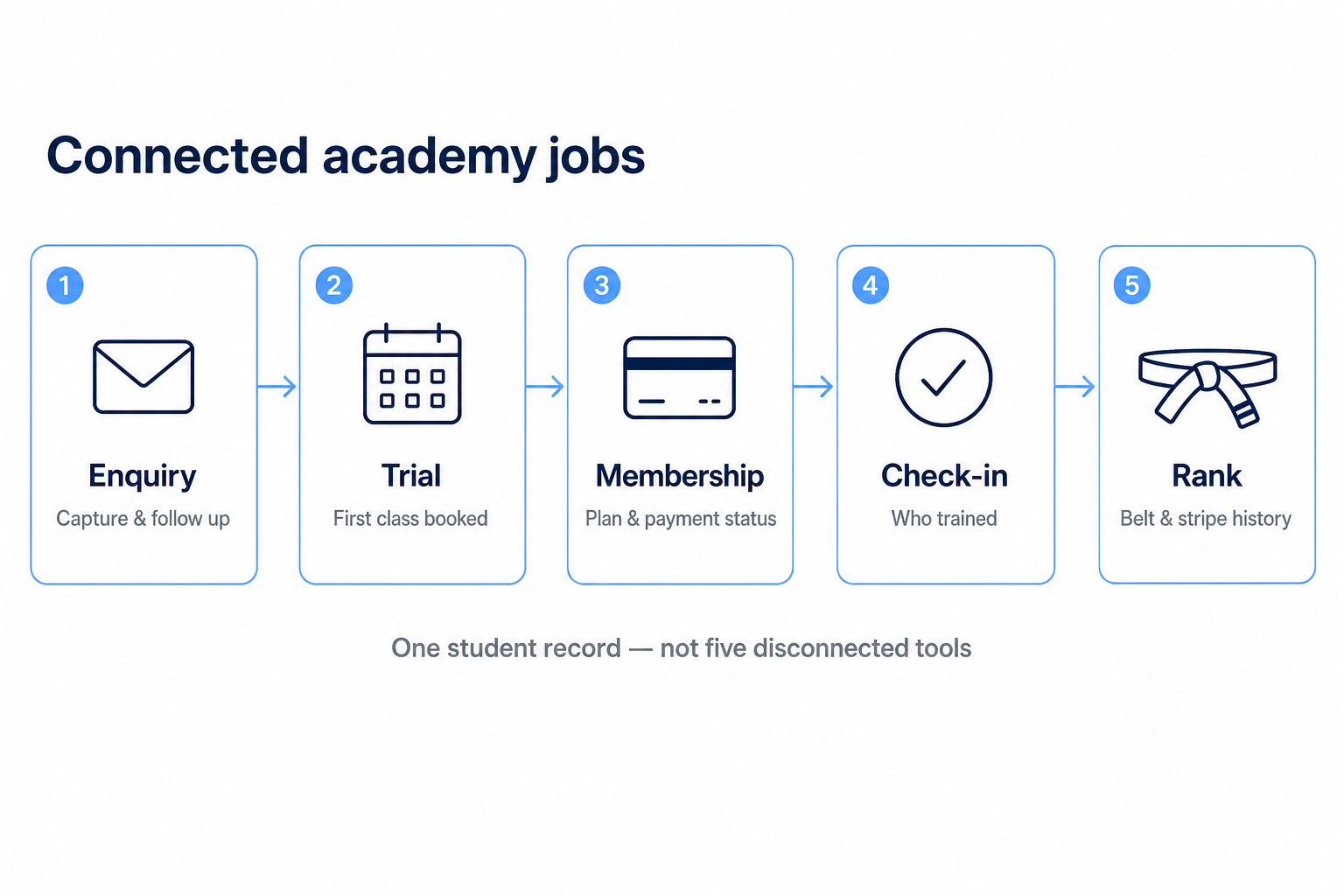
A BJJ academy runs on connected student history: enquiry → trial → membership → check-in → rank over time. If those pieces sit as islands, you become the integration layer — which is a terrible second job when you’re also teaching.
Generic fitness software is often built around access and transactions: swipe in, use the equipment, pay monthly. A BJJ academy is built around progression, class culture and long relationships. You can make a generic tool work. You’ll usually pay for it in workarounds: extra spreadsheets, manual rank lists, and coaches who stop trusting the system because it never quite matches what happens on the mats.
Jobs that matter more as you grow
An owner-operated academy and a gym with several paid coaches do not need the same setup. Buying every “later” feature on day one often just adds complexity you will not use yet.
| Job | Often enough early on | Usually matters more later |
|---|---|---|
| Staff access | Owner handles almost everything | Coaches need limited access without seeing every financial detail |
| Lead ownership | One person replies to everything | Several people share follow-up without double-messaging |
| Reporting | A short weekly look at payments and quiet members | Clearer revenue, attendance and trial conversion views |
| Private lessons | Booked in a chat | Availability, booking and payment in one place |
| Shop / extras | Occasional gi sales elsewhere | Gis, credits or add-ons without a second till |
| Multi-location | One mat space | Shared standards without mixing the wrong rosters |
Good software should be able to grow with the academy: simple enough to start with the day-one jobs, then let you switch on extra capability when you actually need it — private lessons, a shop, tighter staff permissions, clearer reporting — without forcing another migration to new software, and without charging you more for it because they have you trapped. Grow into complexity. Don’t buy a complicated setup for an academy you might never become.
A practical way to test any platform
Don’t judge it by the sales pitch. Ask the product to show these jobs — preferably while imagining the rush before evening class, not a quiet demo account:
- A website enquiry becomes a trial booking, then a member on a plan.
- A coach changes Thursday’s class and members see the update without a group-chat announcement.
- A recurring payment fails — and staff and the member both have a clear next step.
- Twenty people check in before class without the session starting late.
- A coach opens one student and sees membership status, recent attendance and belt/stripe history together.
- You can tell active members apart from drop-ins without guessing.
If those six feel clumsy, a longer feature list will not save you.
For a small academy, I’d rather have those jobs done cleanly than a platform stuffed with modules nobody opens. For a larger academy, add permissions, consistent lead handling and reporting — still judged by jobs completed, not by how crowded the settings screen looks.
Where iRoll BJJ fits
iRoll BJJ is BJJ gym management software built around those academy jobs rather than a generic fitness template: lead management, class scheduling and check-in, curriculum and lesson planning, membership billing through Stripe, member management, belt and stripe tracking and a member app.
Being built for BJJ only matters if it still works when you’re actually running the academy. Put iRoll BJJ through the same job tests as every other option, then choose the system that removes the most friction from the way your academy already runs.
Frequently asked questions
Can I start with spreadsheets, or do I need software straight away?
Spreadsheets can work for a tiny roster if one person is disciplined. Things usually start to fall apart when enquiries land in different places, payments fail quietly, or a second coach needs the same information you keep in your head. If you’re already teaching full evenings, it’s usually better to get clear memberships, a timetable and basic attendance in place now than to rebuild everything later when you’re under pressure. Use this spreadsheet vs BJJ gym management software guide to decide whether to keep, tidy or replace your current setup.
Is martial-arts or BJJ-specific software always better than generic gym software?
Not automatically. Some academies run generic tools successfully. The common failure mode is not “missing a checkbox” — it’s disconnected pieces and a student model that treats people like access-card subscriptions. If a platform can’t show attendance, membership and rank history working together, calling itself BJJ software doesn’t count for much.
Should gym software include a full teaching curriculum?
Yes, if it helps coaches plan and share what gets taught — not just store a document. Most gym platforms barely cover this, so a curriculum or lesson-plan feature that ties into the timetable is a genuine differentiator. It still has to fit how your coaches teach.
What’s the difference between this and a software buying guide?
This article defines the jobs worth buying for. A buying guide helps you compare vendors, cost, migration and trials once those jobs are clear. Use both: jobs first, scorecards second.