BJJ Member Retention: How to Spot Students at Risk of Leaving
By iRoll BJJ
The cancellation email is rarely the start of the story. By the time someone asks to stop their membership, they’ve often already stopped training. The useful work happens earlier: noticing that a regular has gone quiet, while there’s still a relationship to work with.
You don’t need a fancy churn model. You need a reliable attendance record, a short weekly look at who has dropped off their normal rhythm, and a human message that sounds like interest rather than a debt-collection script. Spot the change while they’re still on the books. Act while a quiet word after class still means something.
They stop training before they cancel
Most academies watch the wrong moment.
The dramatic event is the leave request. The earlier signal is usually simpler: they used to show up, and now they don’t — or not as often. Fitness-centre research has long treated visit patterns as one of the clearest behavioural clues around membership risk. That doesn’t mean BJJ gyms behave exactly like commercial fitness clubs. It does mean “who trained this month?” is a better early warning than waiting for someone to formally cancel.
There’s a second trap. Paying members who have stopped attending can look fine on a billing report. The membership is still active. Revenue still looks healthy. The mats already know the truth.
So treat retention as an attendance problem first, and a cancellation problem second.
Watch people against their own baseline
A once-a-week member who misses a week is not the same story as a three-times-a-week regular who suddenly appears once.
Absolute totals mislead. The signal is the drop relative to that person’s normal pattern.
| What you notice | What it often means | What to look at |
|---|---|---|
| A regular drops from several classes a week to one | Life changed, motivation dipped, or something at the academy put them off | Their usual days, training partners, recent hard rolls or injuries |
| Gaps between visits keep getting longer | Habit is slipping before they’ve decided to leave | Whether one timetable change killed their only reliable slot |
| They book and don’t show, repeatedly | Friction, nerves, or commitment drifting | Class fit, confidence, and whether booking itself feels like pressure |
| New member joins, then barely returns | Habit never formed | First-month onboarding, beginners path, and whether anyone followed up |
| Still paying, not training | Quiet quit in progress | Last attended date, not just subscription status |
You can ignore one quiet week. Two or three in a row for someone who used to be reliable is worth a message.
Warning signs that show up on the mats
Attendance numbers are the spine. Understanding why someone went quiet is what makes the outreach useful.
The training partner left
Plenty of people stay because of who they train with. When that person moves city, gets injured, or quits, the remaining member can lose their reason to come without ever deciding to leave.
They stalled
Blue belt is famous for this, but it happens at every rank. Progress feels slow. Everyone else seems to be getting promoted. Classes start feeling heavier than fun. They don’t announce it. They just train less.
Injury, ego bruise, or a rough roll
Someone gets hurt, or smoked by a newer person, or leaves class embarrassed. A short absence becomes a long one because coming back feels awkward. If nobody notices, awkward wins.
Their only good slot moved
You change the timetable. Their Tuesday fundamentals disappears. On paper they can “just come another night.” In practice, childcare, shift work or travel made that one slot the whole membership.
Kids programme signals
With kids, the early warning often shows up in the child first. They used to bounce in and now hang back. They look flat in class. They need persuading every session. Or they quietly stop enjoying the bit they used to love.
Talk to the child in a light way — what feels hard, what they still like, whether something on the mats put them off. Then speak to the parent as well. Not as a sales chase. As a coach who noticed, cares whether the child is enjoying training, and wants to help. Parents usually feel that. It also means you’re not guessing whether the issue is confidence, a rough class, friendship drama, or something completely outside the academy.
Payment trouble on top of absence
If someone’s card fails but they’re still training three times a week, that’s mainly a billing problem. If the card fails and they’ve also stopped showing up, you’ve got two problems — and chasing the payment alone won’t fix the second one. Handle the billing issue properly — see how to manage BJJ gym membership payments — but don’t treat a payment chase as the same thing as a retention conversation.
New members and established members need different clocks
Someone in their first month has not built a habit yet. Someone who has trained with you for two years and suddenly vanishes usually has a reason.
New members. The risk is that BJJ never becomes part of the week. Getting them from trial into membership is only half the job — see how to turn trial students into paying members. After they join, watch whether they come back for a second and third week. If a new member has an active membership and no recent attendance, that is not “they’re busy.” It usually means nobody has finished helping them settle in.
Established members. The risk is a change from their normal. A two-week gap for a lifelong three-timer is louder than a two-week gap for someone who always trained sporadically around travel. Known holidays and competition camps don’t count the same as unexplained silence.
You’re looking at the same last-attended list either way. You just read a new member’s gap differently from a regular’s.
A weekly retention habit that actually fits academy life
You don’t need a big process. You need a short weekly habit — fifteen minutes on a quiet morning is enough.
- Keep attendance trustworthy enough to use. If check-in is a joke, retention lists are fiction. Start with how to track attendance at a BJJ gym.
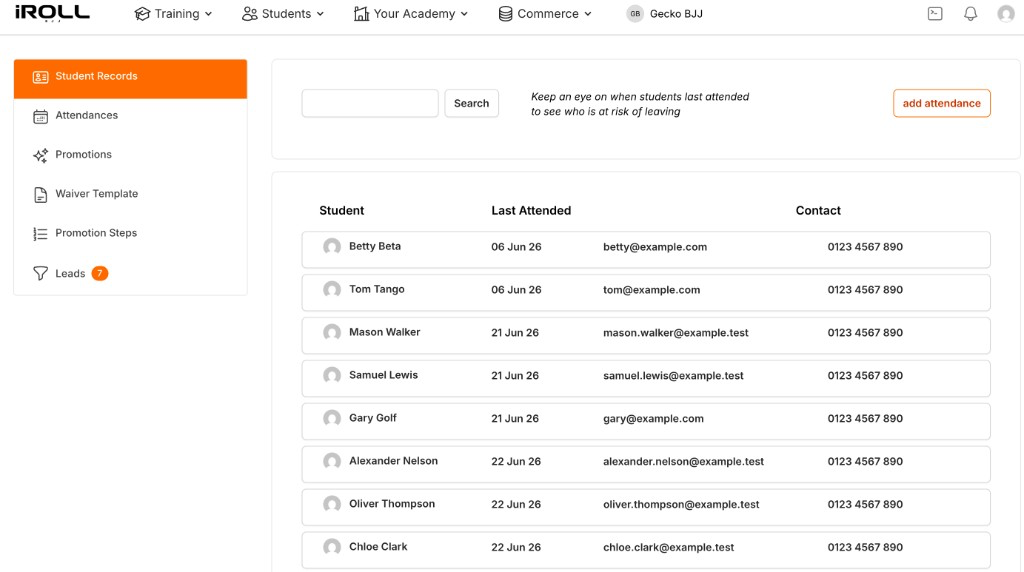
- Once a week, look at who hasn’t trained recently. Sort by last attended. Focus on people who still look active on paper.
- Make a short list. Five names is better than fifty. Prioritise active members with a clear drop from their own pattern.
- Reach out personally. Owner, head coach, or the coach they actually know. One message. Specific. Kind.
- Note what happened. Came back. Pausing for injury. Moving. Unhappy about something. Quiet forever. You only need enough of a note that the next person isn’t starting from zero.
- If the same problem keeps coming up, fix that. If three people all faded after the same timetable change, that is not three separate personality problems.
For a small owner-operated academy, maybe this can live in your head until your student list starts to grow. Once you have several coaches and you are not in every room, the list has to exist somewhere other people can see it. Otherwise retention becomes “whoever remembered to worry.”
What to say when you reach out
The message should sound like someone who noticed, not a system that flagged an attendance number.
Useful shape:
Haven’t seen you on the mats for a couple of weeks — everything alright?
Then stop. Let them answer.
Avoid:
- guilt (“we’ve missed you in class again…”);
- a sales pitch for private lessons in the same breath;
- public call-outs in group chats.
If they reply with injury, life stress, childcare or work, take that seriously. A pause, a different class time, or a soft return plan often beats pretending nothing happened. If they are unhappy about coaching, culture or how a promotion felt, listen properly before you explain why the academy is right. People rarely stay if they feel brushed off.
It also helps to know — or gently ask — why they train and what they actually enjoy. Some people are there for competition. Others want fitness, friendship, an hour after work to de-stress, or the puzzle of getting better at one position. If you push the wrong thing (“come smash open mat on Saturday”), you can make coming back feel worse, not better. Match the next step to what already worked for them.
Some people will leave anyway. Moving house, new baby, money, a different gym closer to work. Retention is not about winning every exit. It is about not losing the people who would have stayed if someone had simply noticed.
What not to obsess over
A dashboard full of “engagement scores” will not save a gym that never sends a message.
You also do not need industry-average retention percentages to run a sensible process. Those numbers vary wildly by business model and how retention is measured. What you need is your own short list, every week, and a habit of acting on it.
And do not confuse “still paying” with “still training.” Billing health matters. Mat health matters earlier.
How iRoll BJJ helps with this
iRoll BJJ keeps attendance on the member record, so “when did they last train?” is a normal question rather than a Sunday-night spreadsheet excavation.
There is a students-last-attended view for exactly this job: scan who has gone quiet, especially people who still look current. The weekly academy report also flags at-risk members, so the follow-up list arrives with the rest of the week’s summary instead of depending on someone remembering to dig.
None of that replaces the message. Software can show you the names. A coach still has to care about the person.
If you are choosing tools more broadly, how to choose BJJ gym management software covers the wider buying decision. For retention specifically, prioritise trustworthy check-in and a last-attended list you will actually open.
Frequently asked questions
How long should someone be missing before I get in touch?
Use their normal pattern, not a universal rule. For a regular who trains several times a week, a couple of quiet weeks is usually enough. For someone who always trained once a week around shift work, wait for a clearer break from their rhythm. New members deserve a tighter clock — if they join and barely appear, do not wait a month out of politeness.
What if they say they’re fine and then still don’t come back?
One follow-up later is reasonable. Three chase messages is not retention, it is pressure. Leave the door open, note it, and spend your energy on the next person on the list.
Should coaches or the owner send the message?
Whoever has the real relationship. In a small academy that is often the owner. In a larger gym, the coach who teaches their usual class will usually get a more honest reply than a generic admin account.
Does failed payment mean they are leaving?
Not automatically. Cards expire. Banks decline things. Treat billing follow-up as its own workflow, and treat unexplained absence as its own workflow. When both happen together, move faster.
Is this the same as getting old members to return after they have already quit?
No. Spotting risk while someone is still a member is earlier and usually easier. Winning back people who already left is a different job, with different timing and different honesty about why they went.
Notice early. Keep it personal.
Retention in a BJJ academy is mostly unglamorous: trust the attendance record, look at it weekly, and send a short message when someone’s pattern changes.
Do that consistently and you will still lose people. You will just lose fewer of the ones who only needed to know someone noticed they were gone.