How to Build and Run a BJJ Curriculum Across Multiple Coaches
By iRoll BJJ
Monday’s coach teaches side-control escapes. Wednesday’s coach did not know that and starts back attacks. Friday turns into open questions because nobody is quite sure what was meant to come next. Every class may be good on its own, but the programme is not moving together.
A useful BJJ curriculum gives coaches a shared direction without trying to script every minute they spend on the mat. It should make the next lesson clear, leave room to adapt for the people who actually turn up, and create a record of what was taught rather than what somebody hoped would be taught.
That becomes especially important once more than one coach teaches the same group. The aim is not to make every instructor sound identical. It is to stop your fundamentals programme depending on whatever the head coach remembers to put in the group chat.
What a BJJ curriculum needs to do
A curriculum is the teaching programme over a period of weeks or months. It is not simply a folder of techniques, and it is not the same as a list of belt requirements.
A workable curriculum should answer four questions:
- Who is this programme for?
- What should those students understand or be able to do?
- What should coaches teach next?
- What did each class actually cover?
The first two are coaching decisions. The last two are where organisation matters. A beautiful syllabus is not much use if the Wednesday coach cannot find it or Saturday’s cancelled class quietly moves everybody past a lesson they never received.
Keep three records separate:
- The curriculum is the wider programme and its sequence.
- A lesson plan is what you intend one class to cover.
- The teaching record is what happened after people stepped onto the mat.
Promotion history is separate again. Curriculum coverage can inform coaches, but it does not show that an individual student has mastered the material or is ready for a stripe or belt. For that administrative side, see how to track BJJ belt and stripe promotions.
Start with the programme, not a giant technique list
Before listing techniques, define the group you are teaching. Adult Fundamentals is a useful example because the programme usually has a clear audience while attendance still varies from night to night.
Decide:
- what the programme should help a beginner understand and do;
- whether students can join at any point or start as a cohort;
- whether the programme loops back to the first module when it finishes or ends after the final lesson;
- which names, coaching cues and safety standards should remain consistent across coaches;
- how much freedom coaches have to change a class;
- whether gi, no-gi and other programmes need separate plans.
Avoid trying to solve every programme at once. Adult Fundamentals and an experienced competition class have different jobs. The first may benefit from a repeating structure that welcomes new starters throughout the year. The second may need shorter blocks that respond to upcoming rulesets, opponents and events.
There is no universal number of weeks or perfect order of techniques. If somebody sells a precise sequence as the answer for every academy, they have probably designed a curriculum for an imaginary room where everyone attends every class and nobody gets injured.
Break the curriculum into modules and lessons
Modules make a longer programme easier to understand. Lessons make it teachable.
An Adult Fundamentals curriculum might contain a Side Control module with lessons such as:
- Survival, posture and frames
- Hip escape and guard recovery
- Underhook escape
- Holding side control under resistance
That is only an illustrative structure, not a claim that every academy should teach those lessons in that order. Your technical priorities should reflect how your academy teaches.
For each lesson, give the coach enough information to understand the purpose quickly:
- a clear objective;
- an ordered running plan;
- rough timings where they help;
- the positions, techniques or drills to cover;
- important safety points or shared coaching cues;
- private notes that members should not see.
The Australian Sports Commission’s session-planning guidance makes a useful broader point: effective plans should meet the needs and motivations of the people taking part. A lesson plan is a starting point for the coach, not evidence that the same class will work unchanged for every group.
Keep the plan readable. A coach checking their phone shortly before class needs the objective and running order, not an essay that takes longer to read than the warm-up.
Decide how the programme advances
The way lessons move through the timetable affects attendance, repetition and coach handovers. Two common approaches are weekly progression and progression on each class date.
| Approach | How it works | Usually suits | Main trade-off |
|---|---|---|---|
| One lesson per week | Every relevant class during the week shares the same lesson or theme | Programmes where members attend different days and several coaches share delivery | Some members see deliberate repetition |
| One lesson per class date | Each scheduled class moves to the next lesson | Stable cohorts expected to attend in sequence | Absences and timetable changes create larger gaps |
Weekly progression can work well for Adult Fundamentals. A student who trains on Monday one week and Wednesday the next still stays within the same wider sequence. Coaches can also compare how different groups responded to the material.
Progressing on every class date moves faster and may suit a fixed course or cohort. It asks more of your attendance and handover process. If someone misses Tuesday, Thursday may assume knowledge they never received.
Neither approach is automatically better. Choose one deliberately, then make sure the timetable and coaches follow the same rule. Class-scheduling software can organise when sessions happen; the curriculum answers what those sessions are working through. For designing the weekly schedule itself, see how to build a BJJ class timetable that works.
Give coaches a shared plan without scripting them
Consistency does not mean every coach must use the same words, demonstrations and drills.
Decide which parts are fixed and which parts are adaptable. A sensible split might be:
Shared across the programme
- the lesson objective;
- core safety requirements;
- important terminology;
- where the lesson sits in the wider progression.
Adaptable by the coach
- the exact demonstration;
- drills or constraints;
- pacing;
- how much detail the group can handle;
- whether part of the lesson needs another week.
Good coaches need room to coach. At the same time, “use your judgement” should not mean nobody else can tell what was taught. The curriculum provides direction; the coach responds to the room.
It also helps to agree who can change the source programme. If every instructor edits the master lesson after teaching their own version, the curriculum soon becomes a record of competing preferences. Let coaches adapt an individual class, then give one person or a small group responsibility for permanent curriculum changes.
Make the coach handover part of the system
A reliable handover should not require the outgoing coach and incoming coach to be online at the same time.
Before class, the instructor should be able to see:
- the intended lesson;
- its objective and running order;
- what the previous class covered;
- anything that needs repeating;
- relevant coach-only notes;
- whether tonight is a normal curriculum lesson or a one-off change.
After class, they should record enough for the next coach to continue confidently. This need not become a second coaching session spent typing into a form. Marking the sections covered and adding one short note is usually more useful than a polished paragraph nobody reads.
For an owner-led academy, the handover may mainly protect you from your own memory after a long week. Once several people share Adult Fundamentals, it becomes part of running the programme rather than an optional admin habit.
Plan for the week that does not go to plan
Real timetables include bank holidays, substitute coaches, seminars, competition preparation and classes where the group needs another thirty minutes on the first part of the lesson.
Your curriculum process should distinguish between:
- The class did not run. The planned lesson should remain available rather than disappearing.
- One class uses different material. Choose a one-off replacement for that session and record what was actually taught without changing the curriculum for every class.
- Only part of the lesson was covered. Keep a record of the covered sections and decide whether to continue next time.
- The group needs to repeat the lesson. Hold or move the programme intentionally.
This is where a fixed PDF usually fails. It shows the ideal sequence but cannot tell you where Monday’s group now sits after a closure, or why Thursday moved to takedowns for a visiting coach.
The answer is not to ban changes. It is to make changes visible.
Use a simple operating rhythm
The curriculum is more likely to survive if checking it becomes part of the academy’s normal week.
Before a cycle
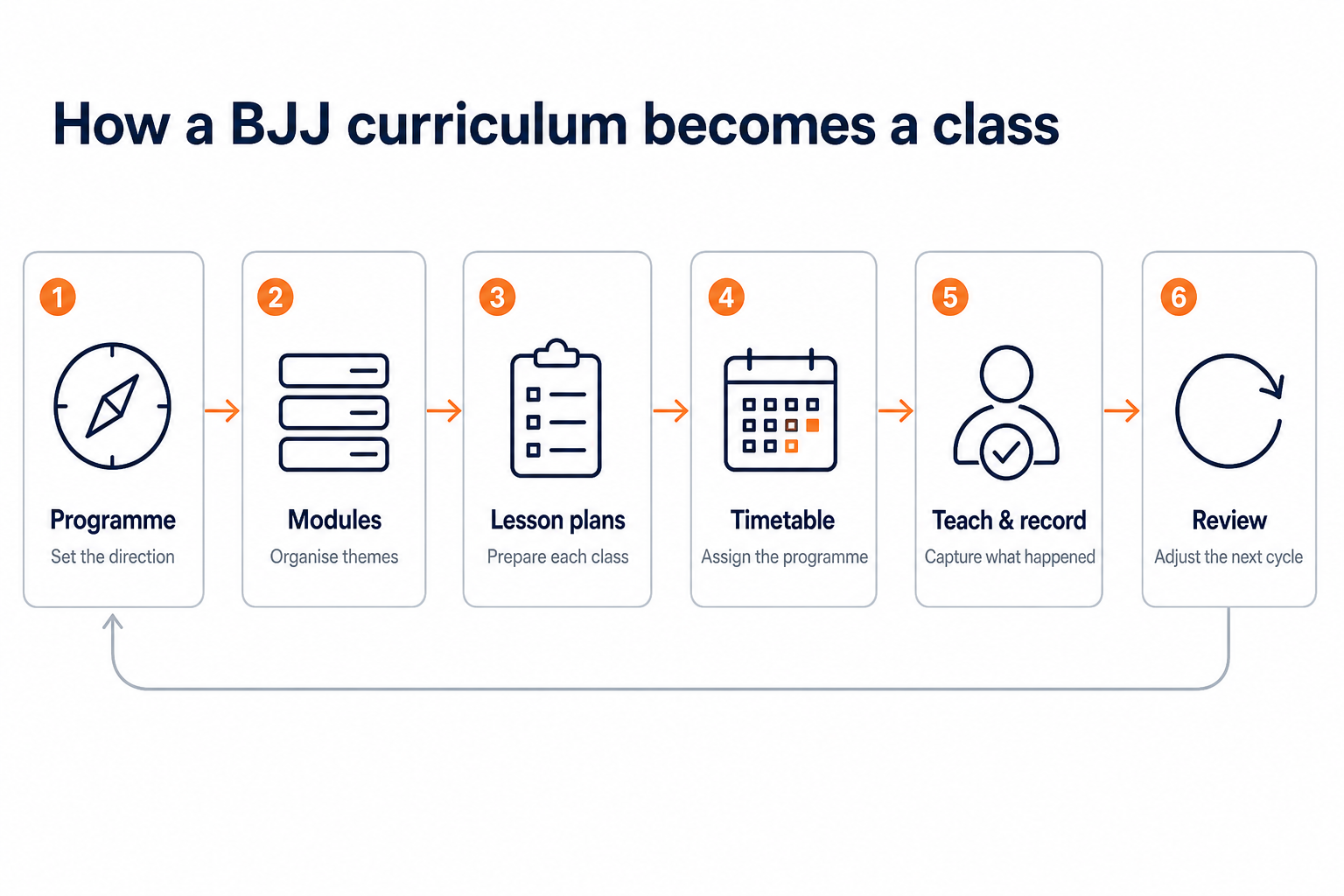
Define the programme, its modules and lessons, and which classes will follow it. Agree how the sequence advances and who owns permanent changes.
Each week
Check upcoming lessons, coach availability and obvious timetable exceptions. This should be a short review, not a curriculum committee meeting every Sunday evening.
Before class
The coach reviews the objective, running order and previous teaching record.
After class
The coach records what was covered and any exception the next instructor needs to understand.
At the end of a module
Review gaps, repetition and pace. Improve the source plans where necessary without rewriting the history of completed classes.
Match the process to the academy
If the owner teaches nearly every class, keep the process light. A short repeating programme, readable lesson plans and a quick record after class may be enough.
When several coaches share a timetable, formalise the handover. Make the next lesson visible, agree shared terminology and record changes. “We covered that last week” is not enough. Record which classes taught it and what they covered, so the next coach does not repeat or skip material by mistake.
Academies running several programmes may need separate curricula, clearer permissions and regular coverage reviews. Do not add that complexity to a single-room academy simply because the software allows it. Use the smallest process that reliably keeps your coaches and classes aligned.
Where iRoll BJJ fits
iRoll BJJ connects BJJ curriculum and lesson planning to the academy timetable.
Owners and admins can build curricula from modules and reusable lesson plans, then assign them to the relevant class types. Each assignment can progress weekly or on each class date. Coaches open the planned lesson from their Teaching Schedule, adapt an individual class when needed and record the material they covered with a single click.
Curriculum Coverage shows planned lessons, recorded classes, replacements and gaps across the timetable. Completed teaching records keep their own snapshot, so editing a reusable plan later does not rewrite what happened in an earlier class.
Academies can also choose to share Class Recaps. These are optional and only available for eligible classes to members who checked in. Coach-only notes remain private.
Software cannot decide the right curriculum for your academy or judge whether a student has learned it. Its useful job is more modest: keep the programme, timetable, coaches and teaching record connected.
Frequently asked questions
How long should a BJJ curriculum be?
There is no standard length that suits every academy. A repeating Adult Fundamentals cycle may run for a defined block, while an advanced or competition programme may use shorter themes. Choose a length your coaches can deliver and review reliably rather than filling an impressive calendar nobody follows.
Should every coach teach exactly the same lesson?
They should share the objective and direction, but they do not need to copy the same script. Give coaches room to adjust demonstrations, drills and pacing for the group while keeping changes visible to the rest of the team.
Should a BJJ curriculum repeat?
Repeating can work well for programmes that accept new students throughout the year, particularly fundamentals classes. A fixed cohort may suit a non-repeating progression. The important point is that coaches and students understand how the programme moves.
What happens to the curriculum when a class is cancelled?
Record that the class did not run and decide whether the lesson stays in place or the programme moves deliberately. Do not let a cancelled timetable entry silently count as teaching.
Is a curriculum the same as belt requirements?
No. A curriculum organises what the academy teaches. Belt requirements describe expectations for promotion, and promotion decisions remain with the instructors. Teaching a lesson does not prove that every student attended or mastered it.
Can a small academy manage this with a spreadsheet?
Yes. A spreadsheet or shared document can be enough while one person teaches most classes. The pressure to use a connected system usually appears when several coaches need the same current lesson, timetable changes affect progression and the academy wants a reliable history of what was taught.
The test is simple: can any coach see what comes next, understand what changed and leave a useful record for the following class? If the answer depends on catching the head coach after training, the curriculum is still living in somebody’s head.