How to Manage BJJ Gym Membership Payments
By iRoll BJJ
Someone walks in for evening class and nobody can say, quickly, whether they’re paid up, past due, on a pause, or halfway through leaving. Cue the polite smile, the sideways glance at whoever “handles the money”, and a conversation neither of you wanted before warm-up.
Managing membership payments well isn’t about finding a clever way to take money. It’s about keeping plans, status and follow-up in one place so coaches aren’t guessing at the door and you’re not piecing together three systems on Sunday night with a cold coffee. Get the lifecycle right — offer a plan, collect on a schedule, catch failures early, handle pauses and exits cleanly — and most of that drama quietly disappears. Which, frankly, is the dream.
There isn’t one perfect setup. A 60-member owner-operated academy can keep things simpler than a 250-member gym with several admins, and that’s fine. The principles are the same either way: clear plans, reliable recurring collection, visible status, and a process people will actually follow when the evening class is packing out.
What “managing membership payments” actually means
Taking the money is only one piece. If the rest of the process is messy, you’ll still end up with the same door-side conversations. You need the whole loop to hang together:
- Plans — what people can buy, and on what terms.
- Signup and first payment — how a new member becomes paid without a chase around WhatsApp.
- Recurring collection — charges that run without you remembering every first of the month.
- Failed payments — spotting them, contacting the member, and deciding whether they can still train until it’s sorted.
- Status — active, past due, paused, leaving, unpaid. Staff should be able to see this without launching an investigation.
- Changes — plan switches, injury holds, cancellations and refunds.
- A basic check that money matches reality — enough reconciliation that surprises don’t wait until your accountant asks.
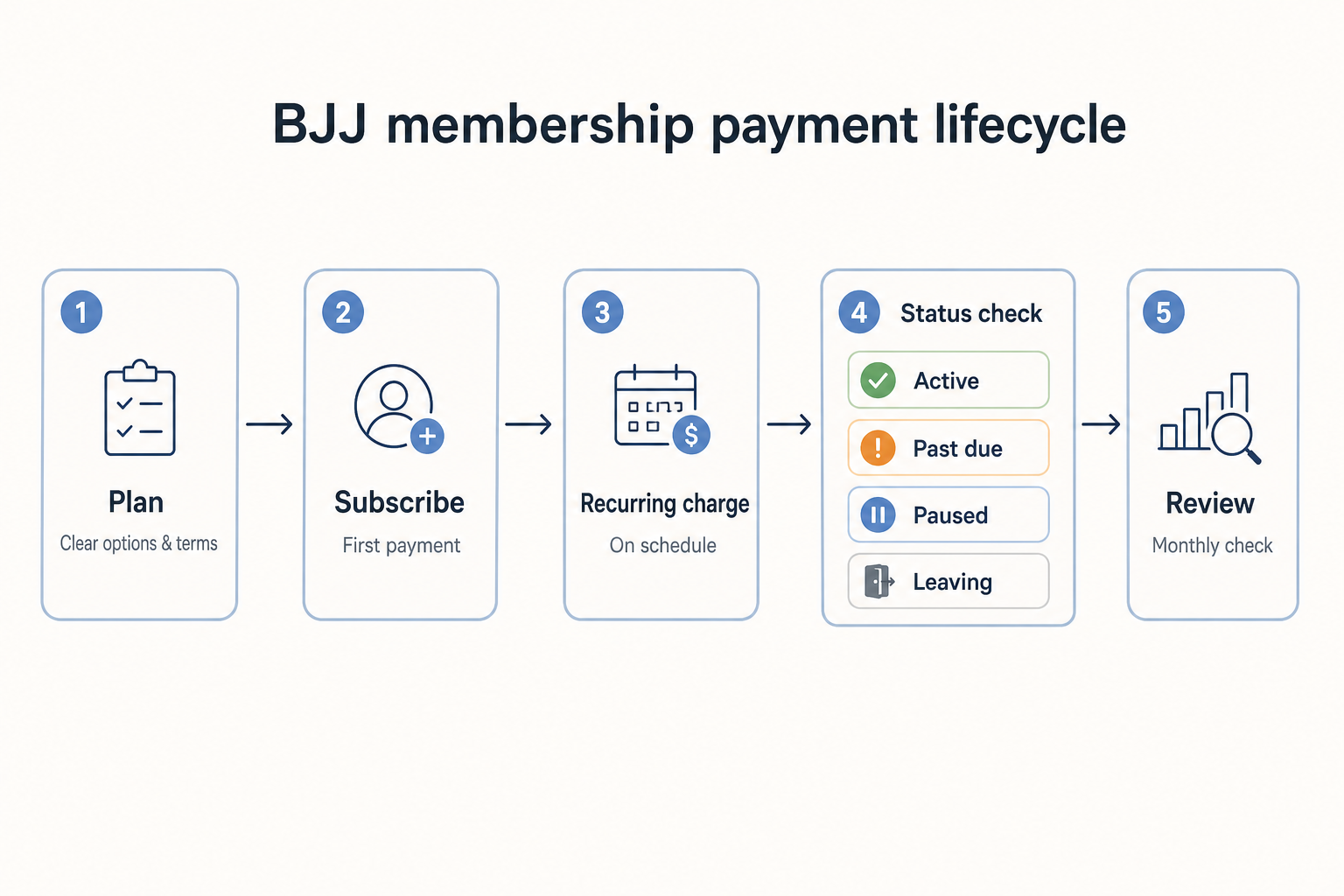
If any of those live only in someone’s head, the system will wobble on a busy week. And busy weeks are not rare in a BJJ academy.
Start with clear membership plans
Before you worry about processors, write down what you actually sell. It sounds basic, and plenty of academies still skip it.
Most academies end up with a small set of recurring options — adults, kids, students, maybe a limited or daytime plan — plus occasional visitors who aren’t on a monthly membership. You don’t need twelve plans because a competitor has twelve. You need plans members understand and staff can explain in one sentence while tying a belt.
For each plan, decide:
- price and billing interval (monthly is common; annual can work if you’re set up to handle it);
- who it’s for;
- whether there’s a trial period;
- what happens if they stop training for a few weeks;
- how notice works when they leave;
- whether family or multi-student arrangements are allowed.
If trials are a big part of how people join, get the handoffs right before the first recurring charge — from enquiry through first classes to signup. How to turn BJJ trial students into paying members covers that journey in more detail.
Write the answers somewhere members can see them. Unclear terms create more admin than a price you might tweak later — and it’s much easier to adjust the price than to keep having “I thought that included open mat?” debates at the desk.
If you still collect some memberships by bank transfer or cash, treat that as a deliberate exception, not the default. Manual collection can work for a tiny group when the owner is organised. It scales poorly, and it turns “have they paid?” into a recurring detective show nobody asked for.
Recurring billing beats chasing people
Automated recurring billing is the default for a reason. Members already live in a world of subscriptions. They expect membership to behave the same way — and you get to stop playing monthly bill collector.
In practice, that usually means:
- the member sets up a payment method once — often a card, or a bank debit such as BACS or ACH where that’s available;
- the charge runs on a fixed schedule;
- successful payments update membership status automatically;
- failed payments surface as something you can act on.
Which method you favour is a separate choice. Cards are familiar and quick at signup. Bank debits can cost less in processing fees and avoid some of the “card expired” churn. Plenty of academies offer both and let members pick.
Ask where the money actually lands. The cleaner setup is that members pay into the academy’s own Stripe account (or equivalent), the processor handles the sensitive payment details, and the gym software tracks membership status — without holding your membership revenue itself. Stripe for BJJ gyms explains the fees, payouts, security and migration questions worth checking. Stripe’s own guidance on automated billing for gyms covers the same core idea: automate collection, give members a way to manage their details, and have a process for failures.
Self-service matters more than people admit. If updating payment details means messaging the owner, waiting for a reply, then turning up early “just in case”, you’ll create more failed payments than you need to. Let members fix their own payment method. The mats are for rolling, not for payment-update counselling.
Failed payments are normal — unmanaged ones aren’t
Cards expire. Bank balances run low. Processors decline things for reasons that make sense only to banks. Failed payments are part of recurring billing. They are not a moral failing, and they are not proof you’ve attracted the wrong members.
What separates tidy academies from chaotic ones is what happens next.
A practical approach:
- See the failure quickly. If you only discover it when someone asks about grading fees three weeks later, the process has already lost.
- Let soft declines retry where the processor supports it. Temporary issues often clear without a human touching anything. Stripe documents automatic retries for failed subscription payments, including Smart Retries and custom schedules. Hard declines — for example a lost or stolen card — typically need a new payment method before another attempt can succeed.
- Tell the member clearly. Say the membership payment failed and give a direct way to update their details. Vague “there was a problem with your account” messages are easy to ignore and slightly alarming for no good reason.
- Decide whether they can still train until it’s sorted. Some gyms keep a short grace period. Others restrict booking or check-in once a subscription is past due. Either can work. What doesn’t work is inventing the rule in the doorway every time, especially with a queue forming behind them.
- Follow up once, then escalate calmly. A short sequence beats one ignored email and then a surprise confrontation after class when everyone’s tired and hungry.
Keep the tone human. Most people aren’t trying to train for free. They forgot, their details changed, or the bank blocked it. Treat the first contact as help, not a courtroom summons. You’ll recover more payments and keep the relationship intact.
For a worked sketch: imagine a £90 monthly adult membership and eight failed renewals in a month. Even if half recover after the member updates their payment method, that’s still real money and several conversations you’d rather not have if you’re hunting failures by hand. The exact recovery rate will vary; the point is that visibility and a repeatable follow-up process beat hoping a generic processor email sorts it on its own.
A deeper playbook for recovery sequences deserves its own article. For day-to-day management, the minimum is cheerful but firm: a list of who needs attention, a clear member message, and a rule for access.
Status should be obvious to staff
Billing only helps if membership status is readable without a treasure hunt.
At a glance, someone on the desk or mats should be able to tell whether a person is:
- Active — paid and current;
- Past due / unpaid — payment failed or unresolved;
- Paused — billing on hold, usually still allowed to train under your policy;
- Leaving — cancellation scheduled, access ending on a known date;
- Not on a plan yet — invited, trialled, or somehow on the roster without a subscription.
If that information lives in a payment dashboard, a separate spreadsheet and a group chat called “admin stuff”, coaches will keep tapping you on the shoulder. Tie status to the member record you already use for attendance and contact details. One place. Fewer hallway consultations.
Be explicit about the difference between pausing billing and ending membership. Pause is for temporary situations — injury is the classic example — where you stop charging but still recognise them as part of the academy. Ending membership is when access should stop. Mix those up and you’ll get either unpaid access that never gets reviewed, or people who think they’ve left still getting charged. Neither is a fun Monday.
Cancellations, refunds and plan changes
Cancellations get messy when nobody has written down how they work.
Decide in advance:
- Can members cancel themselves, or only through staff?
- Does cancellation take effect at period end, or immediately?
- Do you refund unused time as a default, case by case, or never?
- Who can issue a refund, and does a refund also cancel the subscription?
Those last two are easy to mix up. Keep this simple distinction in mind:
Refund = send money back for a charge that already happened.
Cancel = stop the membership so they are not charged again.
A refund does not cancel the membership. A cancellation does not refund money on its own.
That matters in ordinary academy situations:
- Someone was charged twice, or charged the wrong amount, but they still want to train. Refund the mistake. Leave the membership alone.
- Someone is leaving the gym. Cancel the membership (or let them leave) so the next payment does not go out. Only refund as well if you have agreed to give money back.
- Someone is leaving and you’ve agreed to refund unused time. Then you need both steps: cancel the membership and issue the refund.
If you only refund a leaving member, they may still get billed next month. If you only cancel someone who was charged wrongly, you’ve ended their membership when all they needed was the money back.
Plan changes — adult to student, unlimited to limited, adding a child — should be simple and intuitive to do. The messy version is deleting someone and re-adding them so the “new” plan starts clean. That usually breaks history and creates duplicate admin. Future-you will not thank past-you for that shortcut.
Keep drop-ins and one-offs out of the membership muddle
Visitors and pay-as-you-go students are a different problem from recurring members. If you force every drop-in into a fake monthly plan, or track cash drop-ins only in a notebook under the desk, membership reporting gets noisy fast. Suddenly you can’t tell whether your recurring base is healthy or just… blurry.
A cleaner split:
- Recurring members pay a monthly (or annual) membership and train regularly.
- Occasional visitors pay per class, or buy a small pack of class credits they use when they turn up. They’re not on a monthly membership.
- One-off visitors who are unlikely to come back can just pay once — cash at the desk or a single payment link — without being set up as a member at all.
The important part is not to pretend a drop-in is a monthly member. Keep visitor payments separate so your recurring membership list stays honest. For the practical setup, see BJJ drop-ins: pricing, payments and admin.
A simple monthly payment checklist
Once a month — or weekly if the academy is larger — run through a short list. Put it in the diary. Make it a small ritual. It takes less time than the conversations it prevents.
- Who is past due or unpaid right now?
- Who is paused, and should any of those holds end?
- Who is leaving, and does access end when you expect?
- Did collected membership revenue roughly match active paid members × plan prices (allowing for tax, discounts, failures and mid-cycle joins)?
- Are there people training who have no plan and no drop-in arrangement?
That fifth question catches the silent leaks: friends of friends, perpetual “I’ll sort it next week”, and imports that never got a plan offered. They’re almost never malicious. They’re just easy to miss until they aren’t.
You don’t need a finance degree for this. You need a habit — and maybe a nicer coffee while you do it.
Even better: if your gym management software already surfaces the important bits in a weekly report — failed payments, paused memberships, people leaving — most of this checklist becomes a quick scan rather than a treasure hunt. That’s the kind of admin win that quietly saves your evening.
What usually works by academy size
Small owner-operated academy (around 60 members). Keep a short plan list, put everyone you can on recurring billing, and review failed payments a few times a week. You can afford a personal, friendly message when something fails. You cannot afford a system that only lives in your head when you’re away for a seminar.
Growing academy with several coaches. Status has to be visible without asking the owner. Failed-payment follow-up needs an owner — a person or a role — not “someone will notice”. Pause and leave rules should be written so cover coaches don’t invent policy at the door with twenty people waiting to train.
Larger academy (around 250 members, multiple admins). Add clearer permissions around refunds and plan edits, tighter reconciliation, and less reliance on informal exceptions. At this size, “we’ll remember” is how revenue quietly wanders off.
Whatever the size, I’d rather see five well-run plans and a reliable failure process than twenty plans and a spreadsheet of who paid in cash. Simpler usually wins. And it leaves more energy for the bit of the job you actually opened an academy to do.
Where iRoll BJJ fits
If you’re stitching this together manually today, membership billing in iRoll BJJ is built around the same lifecycle: connect the academy’s Stripe account, create the plans you actually offer, let members subscribe through checkout, and track subscription status on the member record. Failed payments surface so the academy can follow up, and the weekly academy report can pull those payment issues into one place so you’re not digging for them. Funds go to your connected Stripe account — iRoll BJJ doesn’t hold membership revenue. Free or manual plans can still work when you’re collecting membership money outside the platform.
That doesn’t replace your policies. It just keeps plans, status and payment outcomes in the same place as the rest of the academy, which is usually where the relief kicks in. If you’re still choosing software, the billing questions in how to choose BJJ gym management software are a useful companion to this guide.
Frequently asked questions
Should every BJJ membership be on automated recurring billing?
For regular members, yes — automated recurring billing is usually the least painful option, whether members pay by card or bank debit. Cash and one-off bank transfers can still make sense for a few edge cases, but they need a deliberate process and clear status. Otherwise “paid” becomes a rumour with good intentions.
How quickly should I follow up on a failed membership payment?
As soon as you know about it. Same day is ideal. Waiting until the member next appears puts both of you in an awkward position and makes recovery harder. Early and friendly beats late and tense.
Is pausing membership the same as cancelling?
No — and mixing them up causes avoidable mess. Pause stops billing for a while and usually keeps the person as a member under your rules. Cancellation ends the membership. Use pause for temporary situations you intend to reverse; use cancellation when access should stop.
Do I need gym software just to take membership payments?
Not strictly. You can collect with a payment processor alone. Software earns its keep when membership status, access and follow-up stay connected to the same member record — especially once failed payments, pauses and plan changes become more common.
Make membership payments the quiet part of the week
When payments are under control, the week gets easier. Plans are clear. Charges run. Failures show up on a list. Pauses have end dates. People who leave actually leave. Coaches can see who’s current without a hallway consultation.
That’s the standard worth aiming for. Build towards it one process at a time, and fix the gaps that cause the most door-side conversations first.