How to Build a BJJ Class Timetable That Works
By iRoll BJJ
A timetable can look impressive and still be awkward to use.
A good BJJ timetable gives members realistic opportunities to train consistently, gives beginners enough suitable classes to attend and can be sustained by your coaches. Start with the smallest timetable you can run reliably. Add classes when attendance and member demand justify them.
Copying the timetable from a successful academy across town won’t necessarily work. Their members, coaches and mat space may be completely different.
Start with the limits
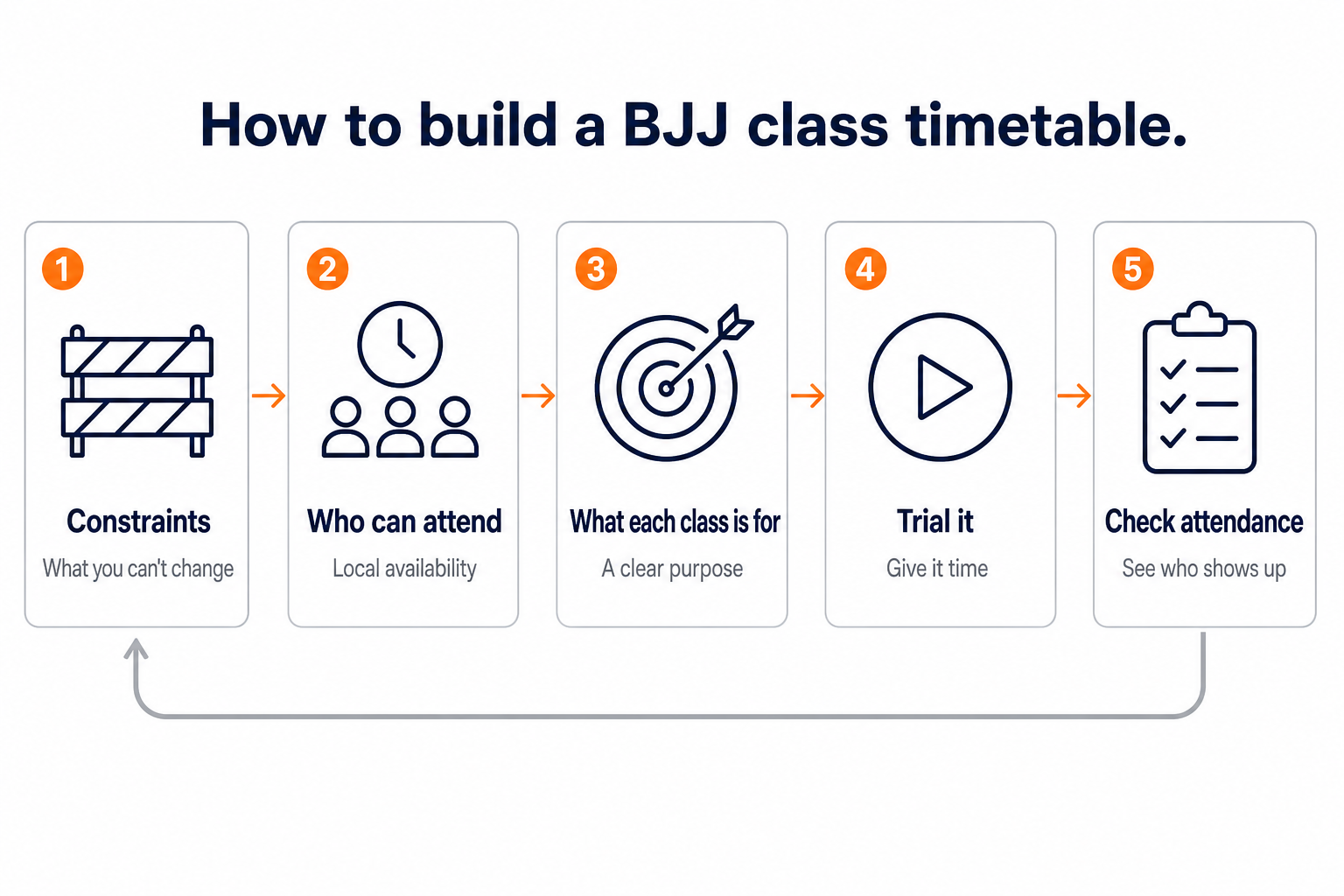
Before deciding which classes to run, write down the things you cannot easily change:
- when the mat space is available;
- when your coaches can teach consistently;
- when people who live or work near your academy can actually train;
- how many people the space can safely handle;
- how long each class and changeover genuinely need;
- which programmes you must accommodate, such as adults, kids or beginners.
Evening and after-school slots are common for a reason, but local patterns still matter. A lunch class may work if enough people are nearby during the day — including people working from home. A city centre with lots of commuting may support lunch or early evening, yet struggle with a late class because people want to get home rather than wait around. Try an unusual slot where you have a real local reason for it, not because another academy happens to run one.
Many academies run classes back to back because mat time is limited. That can work if people leave and arrive quickly and respectfully. Just don’t pretend the changeover is invisible — kids leaving while adults are trying to get on the mats is normal, and the coach usually needs a minute to reset the room.
When you review the timetable, the same basics keep coming up: participant needs, coach availability, venue capacity, changeover time and actual attendance.
Give every class a clear job
Each class should exist for a reason.
A fundamentals class gives newer students somewhere appropriate to start. An all-levels class lets members with different experience train together. An advanced or competition class can serve people who need greater intensity or more specialised material. A kids class needs to suit the relevant age group and the practical routine of parents. An open mat creates less structured training time.
You don’t need every variation immediately.
An owner-led academy may begin with a few dependable adult classes, some suitable beginners sessions and a kids programme if there is enough demand and coaching capacity. Adding separate gi, no-gi, advanced, competition and positional-sparring sessions too soon can spread the same members across several quiet rooms.
Fewer well-attended classes usually create a better atmosphere than a large timetable full of sessions that feel half-alive.
Make it easy to build a training routine
Look at the timetable from a member’s point of view.
Can someone who works late train on more than one day? Can a beginner miss their usual class without losing their only suitable session that week? Can parents realistically and consistently collect kids from school and get them to class on time?
Members shouldn’t need to solve a puzzle every week. Repeating important class types at predictable times makes it easier for training to become part of their routine.
This matters particularly for beginners. If their only suitable class runs once a week, one late meeting, family commitment or illness can mean a fortnight away from the mats. You don’t necessarily need a separate beginners class every day, but new students need more than one realistic chance to train each week.
Don’t separate levels before the numbers support it
Separate beginners and advanced classes can improve teaching, but only when enough people attend both.
If splitting one healthy all-levels class creates two thin classes, the timetable has become more precise on paper and worse on the mats.
A practical middle ground is to run:
- dedicated fundamentals sessions for beginners;
- all-levels classes open to a wider group;
- advanced or competition sessions only where there is enough regular demand.
You can also structure an evening so a fundamentals class leads into sparring or more advanced work. That lets newer students finish after the first section while experienced members stay longer, without requiring two completely separate crowds.
The labels should match what happens in the room. Calling a session “advanced” is not useful if nobody knows who can attend or what makes it different.
Fit the timetable around the coaching team
A timetable that depends entirely on one person is fragile.
If the head coach becomes ill, travels to a competition or simply needs a night away from the mats, what happens? Decide which classes another coach can cover and make sure they can see what is scheduled.
Once several coaches share the timetable, connect class scheduling with a clear teaching plan. A BJJ curriculum can help different coaches keep the programme moving without requiring everyone to teach in exactly the same way.
Use attendance to improve the timetable
Member requests are useful, but they aren’t the same as attendance. Five people may ask for a 6am class and only one may appear after the first enthusiastic week.
Treat new sessions as tests. Give them enough time to settle, then look at:
- how many people attend regularly;
- whether the same small group values the class;
- whether another class became quieter after it was added;
- whether the session attracts people who otherwise could not train;
- whether the coach and time slot remain sustainable;
- what members say about the class.
A quiet class is not automatically a bad class. A beginners session may be valuable because it gives new students a safe entry point. A daytime class may serve members who cannot attend evenings. Judge it by the job it is meant to do, not only by whether it is the busiest session.
On the other hand, keeping a class forever because three people once requested it is not a strategy.
Reliable attendance tracking makes these decisions easier. Look for patterns over time rather than reacting to one quiet night during a holiday week.
Change the timetable carefully
Members build work, childcare and family arrangements around regular class times. Frequent changes make the timetable difficult to trust.
Before making a major change:
- Check attendance and booking patterns.
- Speak to the coaches affected.
- Ask the members who actually use the class.
- Decide what problem the change is meant to solve.
- Give clear notice.
- Update every place where the timetable appears.
Avoid maintaining one timetable on your website, another in an app and a third in a social-media post. As soon as there are different versions of the timetable out there, somebody will arrive at the wrong time.
Reviewing the schedule occasionally is sensible. Constantly rearranging it is not.
Where iRoll BJJ fits
Class scheduling in iRoll BJJ lets an academy create class types with optional age and belt restrictions, publish its timetable to the member app and website, and choose where booking is required.
Members can see eligible classes, book where appropriate, receive reminders and check in through the app or at the academy. Attendance then gives you evidence for deciding whether the timetable is working.
The timetable can also connect to curriculum and lesson planning, so coaches can see what is planned for the classes they teach.
Software won’t decide which classes your academy needs. Its job is to make your chosen timetable easy to publish, run and review.
Frequently asked questions
How many classes should a BJJ academy offer?
There is no useful universal number. It depends on member availability, coaching capacity, mat space and the programmes you run. Start with a schedule you can deliver consistently and add sessions when there is evidence that people will attend them.
Should beginners and advanced students train separately?
Dedicated fundamentals classes can give beginners a clearer start. All-levels classes still provide flexibility and let the academy maintain healthy class sizes. Separate advanced sessions when attendance and coaching capacity support them.
Should members have to book classes?
Booking can help where space is limited or coaches need to know expected numbers. It can create unnecessary friction for ordinary sessions with plenty of capacity. Use it where it solves a real problem rather than requiring it everywhere.
How often should the timetable change?
Change it when attendance, member needs or coaching availability show that something is no longer working. Keep successful core sessions predictable and avoid reacting to isolated quiet weeks.
Build the timetable you can sustain
Start with your mat space, coaching capacity and the people you actually expect to attend. Give each class a clear purpose and make sure members have a realistic way to train regularly.
Then leave the timetable alone long enough to learn from it.
A smaller schedule that members understand and coaches can deliver consistently is a better foundation than a crowded calendar built around classes you hope somebody might attend.