How to Turn BJJ Trial Students Into Paying Members
By iRoll BJJ Updated
Someone fills in the form on your website on Tuesday. By Friday they’ve tried another academy that replied the same evening, booked them onto beginners, and already knows their name. Your enquiry is still sitting in a coach’s personal inbox under “I’ll get to that after class.”
Turning trial students into paying members isn’t mainly a sales script problem. It’s a process problem. People lose interest fast, life gets in the way, and BJJ can feel intimidating on night one. The academies that convert well don’t rely on hoping a great class is enough. They make each next step obvious, follow up while the interest is still warm, and ask for the membership when the person has had a proper taste of training — not after they’ve quietly drifted off.
There isn’t one perfect process. A 60-member owner-operated academy can keep this personal and still be consistent. A larger gym needs clearer ownership so follow-ups don’t depend on whoever happened to see the email. Either way, the job is the same: get them from enquiry to first class, back for a second, then into a membership without making the process feel like a timeshare pitch on the mats.
What “converting a trial” actually means
“Conversion” sounds like a marketing dashboard. In a BJJ academy it usually means a simpler sequence of moments, and people can drop out of any of them:
- Enquiry — they get in touch.
- Booked trial — a date and class are agreed.
- First class attended — they actually walk onto the mats.
- Second class — they come back, which is where curiosity starts turning into habit.
- Ask them to join — someone makes a clear, human invitation to become a member.
- Paying member — plan chosen, payment set up, record created.
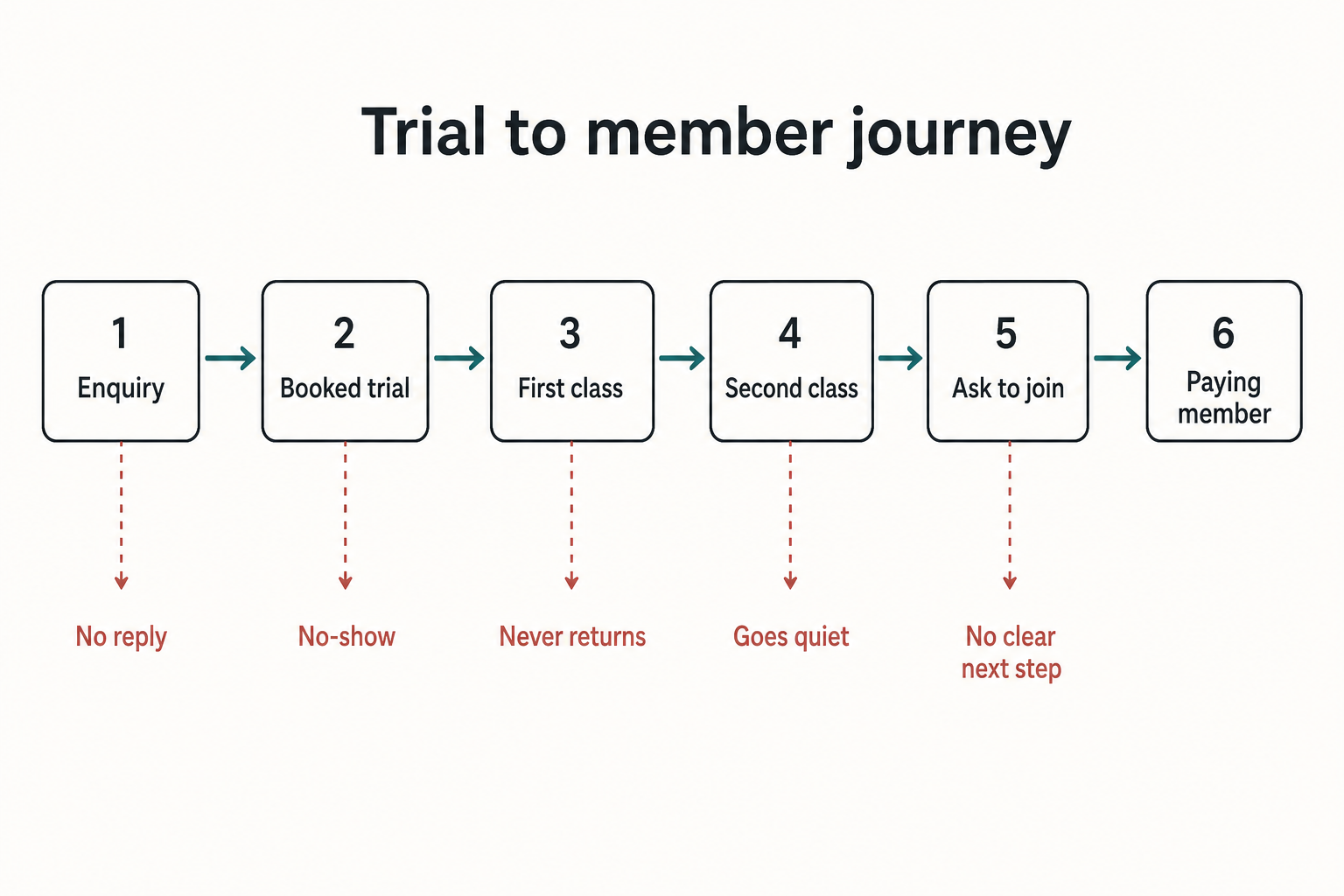
If you only measure “how many people filled in the form” and “how many signed up eventually”, you won’t see where you’re losing them. A gym can look busy with enquiries and still have a quiet membership list because nobody owns the middle of that journey.
Treat each stage as a handoff. When the handoff is vague — “come down sometime”, “message us when you’re free”, “we’ll sort membership later” — people disappear without drama. They just never reply.
Reply while they’re still thinking about it
Speed matters more than perfect wording.
Someone who enquires on their lunch break is comparing options, asking a friend which gym is friendly, and already half-talking themselves out of it. If your first reply arrives two days later with “Sorry, busy week on the mats!”, you’ve made their hesitation easier.
Research on web-generated sales leads — not BJJ-specific, but useful — has repeatedly found that online enquiries go cold quickly. A Harvard Business Review summary of that work reported that many companies responded slowly or not at all, and that firms contacting leads within an hour were far more likely to qualify them than those waiting longer. You don’t need to copy a call-centre playbook. You do need a reply the same day, ideally within the hour when someone is around.
A good first reply does three practical things:
- acknowledges them by name;
- answers the practical questions (what to wear, which class to start with, where to park, whether they’ve done BJJ before);
- offers a specific next step — a class time, not a vague invitation.
“Come try a class sometime” feels friendly and converts poorly. “We’ve got beginners on Thursday at 6:30 — want me to put you on that one?” gives them something to accept.
Keep enquiries somewhere the academy can see them, not only in one person’s WhatsApp. A simple BJJ gym lead-management process gives each enquiry an owner and a clear next action. If the owner is travelling to a competition, someone else still needs to know a new adult beginner messaged an hour ago.
Get them to the first class — then make the second one easy
The gap between “sounds interesting” and “shoes off, on the mats” is where a lot of trials die.
No-shows are normal. People get nervous. Work runs late. They can’t find a rashguard. A short confirmation the day before or morning of the class helps: time, what to bring, where to arrive, and that it’s fine to be a beginner. You’re not nagging. You’re removing friction from a decision they’ve already half-made.
When they do show up, the first class has one job: leave them wanting the second.
That usually means:
- someone greets them before they’re left hovering by the changing rooms;
- a coach knows it’s their first time;
- they’re paired sensibly, not thrown into the deepest end of sparring with no context;
- they leave with a clear invitation to a specific next class.
The membership conversation can wait. If someone is still catching their breath and wondering whether they embarrassed themselves during warm-up, launching into plan pricing is tone-deaf. Book the next class while they’re there. “Same time Thursday?” beats “Let us know if you want to join.”
I’d treat the second class within about a week as the real early signal. One visit can be curiosity, a favour to a friend, or a free class they felt they should use. Coming back means they’re starting to fit BJJ into their week. Optimise your follow-up for that return, not for extracting a card payment before they’ve trained twice.
If they miss the second class, don’t wait three weeks and then send a long email. A short message or call within a day or two — “Did Thursday not work? Want another beginners slot?” — is usually enough. Plenty of people intend to come back and simply never reopen the chat.
Ask them to join
At some point you need to ask.
Not with a brochure dump. Not with a pressure tactic that would make you leave a car dealership. With a plain conversation from someone they already trust — often the owner or the coach who taught them — that references what they’ve actually done on the mats.
Useful ingredients:
- timing after they’ve trained more than once, when the novelty is still high and the excuses haven’t piled up;
- a short reminder of what membership includes (classes, open mat, whatever is true for your gym);
- the plans you actually recommend for someone like them, not a menu of twelve options;
- a clear way to sign up that doesn’t involve “message me and I’ll send a link later when I’m at a laptop.”
If the signup path is awkward, people stall. “I’ll do it this weekend” is often the last you hear from them.
Be honest about commitments and cancellations. BJJ memberships are recurring. People will ask. Clear terms build more trust than a soft sell that leaves the awkward details for later — especially once you’re managing membership payments for real, with pauses, failed payments and exits in the mix.
And if they’re not ready, mark that clearly and follow up once more later. Ghosting a warm lead because they didn’t join the first time you asked is how academies invent the myth that “people around here just aren’t serious.”
Free first class or paid intro?
Both can work. They solve slightly different problems.
A free first class lowers the barrier. Good when people are nervous, your market is less familiar with BJJ, or referrals are already warm and just need a low-friction start. The downside is you can fill beginners classes with people who were only ever going to try it once, and an open-ended “free trial whenever” is hard to manage. If you offer free, keep it bounded: one class, or a short window, with a clear end.
A paid intro — for example a week or a small pack of classes for a modest fee — asks for a bit of commitment up front. That often filters for people who already intend to train, and it gives them enough sessions to feel the habit forming before the full membership conversation. The downside is fewer people will enquire in the first place.
I wouldn’t pretend there’s a universal winner. For an established academy in a busy market, a short paid intro is often cleaner to run. For a newer academy trying to get people through the door, a well-handled free first class with tight follow-up can be the better trade. Either way, decide the offer, write it down, and stop inventing custom deals in the corridor before class.
A deeper free-vs-paid comparison deserves its own article. For conversion, the offer matters less than having a simple process for each stage, and someone who will actually follow it.
What usually works by academy size
Small owner-operated academy (around 60 members). You can answer enquiries personally and still keep a simple list: new, contacted, trial booked, attended, joined, not interested. Confirm trials yourself. Ask them to join in person after class two or three. The process will probably already feel personal. The real risk is enquiries vanishing when you’re teaching back-to-back or away for the weekend.
Growing academy with several coaches. Assign ownership. Website enquiries need a named person or rota, not “someone will see it.” Trial students should be flagged so the coach on that class knows who’s new. Asking them to join can still be personal, but the reminders and status tracking need to survive shift changes.
Larger academy (around 250 members). Add clearer stages, reporting on where people drop out, and less reliance on memory. You can automate confirmations and routine nudges. Asking them to join still needs to come from someone they know — in person, or in a message from the coach who taught them.
Whatever the size, I’d rather see a simple process followed every time than a sophisticated CRM nobody updates after Wednesday night fundamentals.
What to track (without drowning in metrics)
You don’t need a growth board covered in charts. A handful of counts, reviewed weekly, is enough:
- new enquiries;
- trials booked;
- first classes attended (and no-shows);
- second classes attended;
- memberships started from trials;
- how long enquiries sit unanswered.
Look for the fattest leak:
| What you notice | What to look at |
|---|---|
| Enquire but don’t book | The reply, or your class timetable |
| Book but don’t show | Confirmation, and first-night nerves |
| Train once and vanish | The second-class invite and follow-up |
| Keep training on a trial | How you ask them to join, or the sign-up process |
Avoid inventing a “good” conversion percentage from the internet and then feeling bad. Track your own baseline for a month, then improve the weakest stage.
Where iRoll BJJ fits
If enquiries currently live in scattered inboxes, lead management in iRoll BJJ is built around the same idea: put a form on your academy website, get notified when someone enquires, keep prospective members on one lead list with a clear status, and convert the lead into a member when they join — including inviting them into the academy from the lead record so you’re not retyping everything.
That doesn’t replace a good first class or a human membership conversation. It stops the admin side of the journey from depending on who remembered to check their phone. Once they join, membership billing and member management pick up the next part of the story.
If you’re still choosing software, the lead and trial questions in how to choose BJJ gym management software are a useful companion to this guide.
Frequently asked questions
How soon should I ask a trial student to become a member?
After they’ve trained more than once, while interest is still high — often within the first week or two if they’re attending. Asking before they’ve taken a proper class can feel pushy. Waiting until they’ve gone quiet makes the conversation colder than it needed to be.
What if someone wants to “think about it”?
That’s normal. Give them a clear way to join, agree a light follow-up, and mark the status so the lead doesn’t vanish. One thoughtful check-in beats a drip of generic messages.
Should coaches or the owner invite them to join?
Whoever the trial student already trusts. In a small academy that’s often the owner. In a larger gym it can be the coach who taught them, as long as pricing and signup are consistent. Avoid leaving it to an automated email that ignores what happened on the mats.
Do I need gym software to convert trials?
No. A shared list, fast replies and a clear signup path can work. Software helps when enquiries, status and membership creation need to stay connected as volume grows — and when you don’t want the process living only in one person’s head.
Make joining the natural next step
A trial becomes a membership when the journey is easy to follow. Reply quickly. Book a real class. Make the first session welcoming. Get them back for a second. Ask clearly. Sign them up without a scavenger hunt for payment links.
Do those things consistently and you won’t need a dramatic sales overhaul. You’ll just stop leaking people who already liked your academy enough to enquire in the first place.