How to Track BJJ Belt and Stripe Promotions
By iRoll BJJ
The night before a grading, someone is usually reconstructing history. A photo of a kid’s belt from last summer. A coach saying they’re pretty sure she’s on two stripes. A spreadsheet last touched when the previous admin left. Meanwhile a parent is asking whether their child is “due”, and an adult blue belt is quietly convinced they’ve been forgotten.
Tracking promotions is not the same as deciding them. You need a shared record of where someone is, when they were last promoted, and what evidence you have. The decision still belongs to the instructors. IBJJF sets minimum ages and time in rank, but even they leave when to promote with the professor.
A 60-member owner-operated academy can keep promotions personal. Consistency is still the hard part. Knowing your regulars is not the same as remembering every kids stripe, or what happened the week you were away at a competition. A larger gym hits the same gaps sooner, and needs a roster other people can use when the head coach is teaching the other room. Either way, the job is the same: a current rank you trust, a dated history, and a way to record the next promotion while you’re still on the mats.
What you’re actually trying to keep
“We know everyone’s rank” isn’t a system. It works until a cover coach runs kids class, a student transfers in from another academy, or you try to answer a simple question: when did this person last get a stripe?
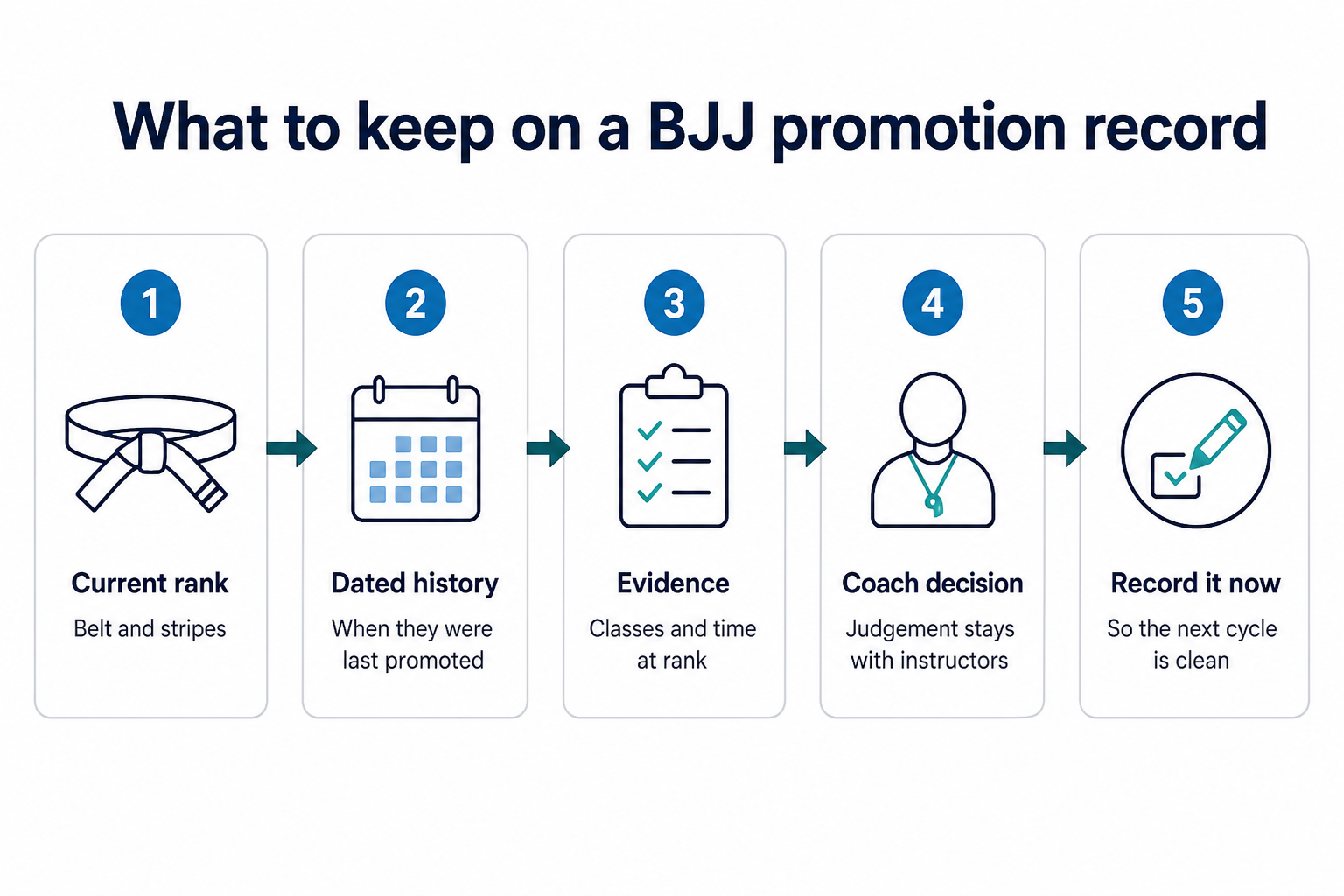
A clean way to run promotions needs five things:
- Current rank — their belt and stripes, written on their record, not only remembered.
- Dated history — when they were last promoted, and from which rank.
- Evidence — classes since the last promotion, and how long they’ve been at this rank.
- A decision — a coach or professor actually promotes them.
- The write-up — the new rank is recorded the same day, so the next cycle starts clean.
If any of those live only in memory, grading day turns into a scramble to reconstruct everything. The record is there to keep things fair and organised. It isn’t there to trap students, and it shouldn’t pretend to replace mat time, attitude or actual skill.
You don’t need a novel for every student. Starting rank plus dates is enough. Notes help when someone joins mid-stripe from another gym, takes a long injury break, or skips a step for a reason you won’t remember in eighteen months.
Where IBJJF fits
Plenty of academies are not IBJJF-affiliated, and plenty of members never compete. Even then, IBJJF’s belt structure is the one most academies follow in practice, and it is the set of rules that matter if a student later wants to register for IBJJF competition at that rank.
IBJJF’s General System of Graduation (the June 2026 revision on their site) splits the sport in a way that matches how academies actually run:
- Ages 4 to 15: kids colours in groups — grey, yellow, orange and green, each with white, solid and black variants.
- Ages 16 and up: the adult ladder — white, blue, purple, brown, black.
Age in that system is a calendar-year calculation (current year minus birth year), not “have they had their birthday yet”. Anyone turning 16 in the current year moves onto the adult colours. Grey, yellow or orange becomes blue. Green can become blue or purple, at the professor’s decision. That transition is where academies quietly create mess if kids ranks and adult ranks live in different notebooks.
For adult promotions that IBJJF will recognise, the usual minimums are:
| Next belt | Minimum age | Usual minimum time at the previous belt |
|---|---|---|
| Blue | 16 | None at white |
| Purple | 16 | 2 years as blue |
| Brown | 18 | 18 months as purple |
| Black | 19, or 18 if Adult World Champion at brown | 1 year as brown |
Those time figures are the common adult path. IBJJF lists extra exceptions for juvenile history and for Adult World Champions, and it counts the clock from IBJJF registration of that belt, not from the day you gave them a stripe on the mats. Teens at 16 and 17 can hold blue or purple; brown waits until the adult division.
Two points in that document matter for day-to-day academy tracking. The time from white to black is at the professor’s discretion. IBJJF will only recognise the graduation if the mandatory minimums are met.
In plain terms: your academy decides when someone is ready. IBJJF decides whether that rank counts for their competitions and records. If you don’t need IBJJF recognition, you still need an internal rule you can explain. If you do, don’t promote someone into a competition belt you can’t register.
Stripes — IBJJF calls them degrees — are looser. For white through brown, adopting their four-degree pattern is at the professor’s discretion. For kids, IBJJF suggests stripe cadences (monthly, every three months, or every four months) and leaves the choice with the academy. There is no IBJJF minimum time in each kids belt. A deeper look at kids colours belongs in its own guide. For tracking, you only need to know which ladder a student is on, and what “next” means for them.
These rules change. IBJJF’s June 2026 revision, for example, allows black belt at 18 only for athletes who won the Adult World Championship at brown belt. If competition ranks matter to your gym, check the current graduation system rather than an old poster in the office.
Attendance and time are evidence, not a verdict
Lots of academies use a rough class count between stripes or belts. That’s useful context. It shouldn’t be the only thing that decides a promotion.
A student who trained twice a week for a year and a student who appeared twelve times in the same calendar stretch are not in the same place, even if both are “still on one stripe”. Time in rank without mat time is just waiting. Mat time without skill, attitude or recovery from injury is just a number.
Use the record to support the coach’s judgement, not to replace it. If you set an attendance minimum, say so. Make it obvious that hitting the number means “worth a look”, not “the software will now promote you”. That only works if attendance tracking is halfway honest. If half the room trains without checking in, your “ready for a stripe” list is mostly fiction.
You will also get the reverse problem. Some students avoid checking in because they think fewer recorded classes will slow down the next stripe. Sometimes that’s gamesmanship. Sometimes they do not feel ready. If attendance feeds grading, tell people why you record it. The history is there to keep things fair. It isn’t a trap.
For example — and this isn’t a rule — an academy might ask for something like 40 classes before looking at a blue-belt stripe, and still promote earlier after injury, or wait longer if the person isn’t ready on the mat. Write your own numbers down. Don’t copy a forum post and then argue with parents from memory.
How academies usually keep the record
Memory and “I know where everyone is”
Fine when it is the same coach, the same small room, and nobody leaves. It falls over the moment you have cover coaches, a kids programme with fast-moving colours, or an adult who trains mornings while the person who “knows” teaches evenings.
A notebook or a wall chart
Better than nothing, and still common for kids stripes. The failure mode is the same as paper attendance: the chart is in one place, the people who need it are in another, and nobody photographs it before the tape comes off.
Spreadsheets
A tiny academy with one organised owner can make a sheet work. Rank, last promotion date, classes since, done. The usual mess is timing. Names get added after the grading. Kids who turned 16 are still on orange in the sheet. A transfer student is “blue, I think”. By the next grading you trust the sheet less than the coach’s memory, which defeats the point.
Software that stores rank with the member
The point isn’t a fancy belt graphic. It’s that current rank, promotion dates and attendance live on the same student record the coach already uses for check-in. If you are choosing a platform, this is one of the BJJ-specific tests in how to choose gym management software: can staff see attendance beside promotion history, and does the system record belts and stripes rather than a generic martial arts grade?
Running a grading day without reconstructing the list that morning
The tracking problem shows up most clearly on grading day. You don’t need a ceremony plan for that. You need a list you can work down.
A practical order:
- Separate the groups first — kids and adults, or by age — so you are not mixing grading ladders.
- Work lowest ranks first. White belts and early stripes are usually the bulk of the session.
- For each student, confirm the next rank before you mark it. Promoting the wrong stripe in a hurry is an annoying fix later.
- Record it immediately. If you “do the admin tonight”, tonight becomes next week and the dates are wrong.
- Leave a way to handle exceptions: a starting rank, a skipped step, a correction, someone who should wait.
If you use attendance minimums, start with the people who have hit them. Then still look at the rest. Hitting the number should put someone on your radar. It shouldn’t be the only reason you consider someone for a stripe or belt.
After a spreadsheet import, treat incoming ranks as untrusted until someone confirms them. A wrong starting belt throws off every “ready to promote” view that follows.
What usually works by academy size
Small owner-operated academy (around 60 members). You can keep promotions personal. Still write them down. The risk is not that you will forget your regulars. It is the kids colours, the person who trains with a different coach, and the week you are away at a competition. Current rank plus last promotion date is enough. Optional attendance minimums can wait until you stop trusting the vibe.
Growing academy with several coaches. Make the record shared. Coaches should be able to see rank and recent attendance. Keep the actual promotion authority with the people who are allowed to decide rank, so a well-meaning cover coach is not handing out stripes at the end of fundamentals. Agree the kids-to-adult transition in writing: when someone is 16 in the current year, they are on the adult ladder.
Larger academy (around 250 members). You need a roster, filters, and a grading-day workflow that does not depend on one person’s laptop. Confirm ranks after imports. Use attendance as a highlight, not an automatic promotion. Parents will ask where their child is in the queue. A dated history is how you answer without inventing a story in the corridor.
Whatever the size, I’d rather see a simple record updated on the day than a beautiful curriculum document nobody opens when it’s time to tape a stripe.
How iRoll BJJ handles this
Belt and stripe tracking in iRoll BJJ is built around that same split: the software keeps the record, instructors keep the decision.
You set optional promotion steps — belt, stripe, and a class-count target if you want one. Those targets guide the promotions roster. They don’t force a promotion. Attendance since the last promotion is the evidence; class check-in is how that evidence gets there. Members can see their belt, stripes and history on their profile in the member app.
For a grading session, Promote now is the flow designed for working down a group rather than editing people one profile at a time. Open Promotions, filter by age if you are running kids then adults, focus on people who have hit (or very close to) their attendance minimum, and work down the list. Students are ordered lowest ranks first, then by who is closest to the attendance mark, so the next person is usually near the top. Confirm the next rank with a tap, stay on the roster, move to the next student.
None of that replaces a coach seeing how someone rolls. It just helps grading day run smoothly and keeps the session moving.
Frequently asked questions
Does gym software decide when someone should be promoted?
No, and it shouldn’t. Software can show current rank, history and attendance. Instructors decide. If a product offers “auto-promote when they hit 40 classes”, that’s a warning sign, not a feature.
Do we have to follow IBJJF?
Only if you want IBJJF to recognise the rank — typically because students compete in their events or you want their records. Plenty of academies use the same colours and a looser internal timetable. What you shouldn’t do is mix the two silently: promote someone on academy time, then discover they can’t register at that belt.
How many classes should someone attend between stripes?
There is no universal number. IBJJF does not set class counts. Your academy can. Pick a range, treat it as guidance, and look at the person. A separate article can go deeper on that policy choice. For tracking, keep the number consistent — and make sure you can actually measure it.
What if a student joins from another academy?
Record the rank they arrived with, and the date you accepted it. Don’t invent a full history you don’t have. If they compete, their IBJJF registration is a separate question from your internal record.
Should kids and adults use the same tracking system?
Yes for the record, no for the ladder. Same student profile, different next step. The painful moment is the calendar year they turn 16. Decide that transition once, then let the roster follow it.
Get the record right, then grade
Promotions feel like a big deal on the mats. The admin shouldn’t. Current belt and stripes on the member. Dates you can trust. Attendance that helps you decide, without pretending it’s the whole story. A way to record the next rank before people have left the building.
Do that consistently and you’ll spend grading day looking at students, not hunting for last year’s spreadsheet. The tape on the belt can still be the ceremony. The record behind it just needs to be true.